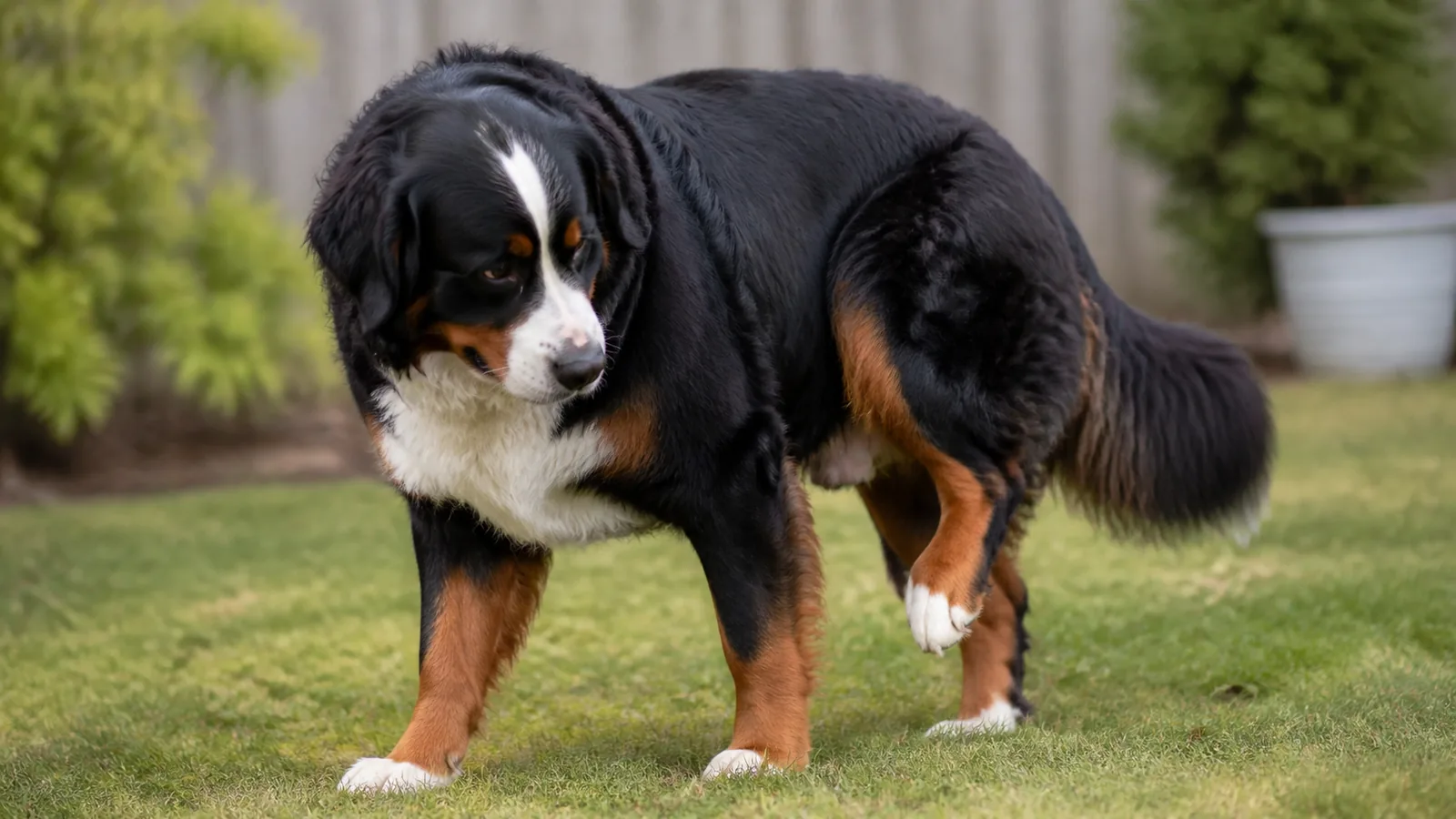
The dogs most likely to tear a cruciate ligament are the ones whose own build works against the knee long before any single bad landing. Part of the risk is built into the dog: breed, body shape, and the slope of the tibial plateau, the top of the shin bone, which sets how much force the ligament takes with every stride. The rest accumulates at home, in extra pounds and weekend-only exercise that fray a ligament quietly for months. That slow wear is why the first sign is usually a limp that comes and goes rather than a dramatic injury, and why the other knee is at real risk too.
At Northwood Veterinary Hospital, we see both kinds of cruciate patients: the dog built for this injury and the dog whose extra pounds wore the ligament down. We examine the knee, take the digital X-rays that show the joint and any arthritis already there, and tell you plainly what surgery can do, because none of these operations put the torn ligament back. Osteotomy procedures like TPLO and the TTA2 we perform here change the geometry of that upper shin bone so the knee stays steady without it, while an extracapsular suture placed outside the joint does the same job for many small and less active dogs, and we'll go over the best surgical plan with you in detail. For the knee that has not torn, an individualized weight and activity plan is the part you can control. If your dog is limping or you are weighing surgery, ask us your questions or schedule an appointment today.
Start Here: What a Torn Cruciate Means
- Most cruciate tears come on slowly, so a limp that fades with rest and returns a week later matters more than one dramatic yelp.
- The ligament doesn't grow back and the knee doesn't steady itself, so waiting usually costs cartilage that can't be replaced.
- The right surgery follows the dog: size, age, activity level, and the slope of the shin bone decide between an osteotomy and a suture placed outside the joint.
- Rehab and body weight do as much for the final result as the operation, and they protect the knee that hasn't torn yet.
Why Do Cruciate Ligaments Tear in the First Place?
Most cruciate ligament injury in dogs builds slowly, the ligament weakening across months of ordinary activity until a routine jump or hard turn finishes the tear. That ligament's whole job is stopping the shin bone from sliding forward under the thigh bone each time the knee takes weight, and a steeper plateau angle makes the job harder with every stride.
So the risk stacks up from a few directions at once:
- Build and breeding: Labrador Retrievers, Rottweilers, Newfoundlands, Staffordshire Terriers, and Boxers show up more than their share. Plateau angle and limb conformation run in families, which is why littermates sometimes follow each other into the same repair.
- Body condition: Extra padding loads the stifle constantly, not just during play. It's also the risk factor most within your reach, and weight and body condition counseling is a standing part of our exams.
- Weekend-warrior patterns: The dog who naps through five workdays and then sprints for two hours on Saturday asks a deconditioned ligament to absorb everything at once.
- Age and the middle years: These tears cluster in young-to-middle-aged large dogs and in older small dogs, though any dog can be the exception.
- The other knee: Once one side goes, the second carries a substantially higher risk.
Which Limps Point to a Cruciate Tear?
The tell is a limp that behaves strangely. A dog who toe-touches after a hard play session, seems fine for a few days, then goes lame again is showing the kind of limping that points to a partial tear rather than a bruised paw. A complete rupture is louder: a yelp mid-turn, then a leg held up.
Between those two extremes, the signs are quiet and easy to explain away:
- The sideways sit: Instead of folding both hind legs underneath, your dog flops the sore one out to the side.
- Everyday movements get harder: Hesitation at the bottom of the stairs, a slower rise from a nap, no more launching into the back of the car.
- Swelling on the inside of the knee: Run a hand down both stifles at once. The injured one often feels fuller and firmer.
- Stiffness that loosens up: Worst after a long rest, better a few minutes into the walk, worse again that evening.
Watch across days, not minutes. If the limp is still around after a few days, or it keeps coming back, that's your cue to come in for an exam and an in-house digital X-ray rather than another week of wondering. One warning while you wait: human anti-inflammatories are off the table for a limping dog; ibuprofen, naproxen, and acetaminophen all cause stomach ulcers and kidney damage at doses that look small. Call us instead and we'll get safe pain control started.
What Happens at the Visit When Your Dog Starts Limping?
A cruciate workup starts with hands on the knee, feeling for swelling, for thickening along the inside of the joint, and for the forward slide of the shin bone a torn ligament allows. X-ray imaging then shows fluid in the joint, arthritis that has already formed, and the slope of the tibial plateau, though the torn ligament itself never appears on the film.
None of it needs a specialist appointment to begin. Hands-on orthopedic exams are ordinary work for us, and the sequence usually goes like this:
- Watching your dog move first: Before anyone touches the leg, we watch the walk and the trot to see which limb is being unloaded and by how much.
- Testing the joint directly: Cranial drawer and tibial compression tests check whether the tibia shifts forward. A tense or painful stifle can mask a partial tear, so sedation is sometimes the only honest way to get the answer.
- Checking everything else: Hips, lower back, and the opposite knee get examined too. A dog carrying weight on three legs is usually sore in more than one place.
- Measuring off the radiograph: The plateau angle helps decide which repair suits the knee in front of us.
Not every sore hind leg is a cruciate. Hip dysplasia, a tick-borne infection like Lyme disease or Anaplasma, a soft tissue strain, and, in older large-breed dogs, bone cancer can all begin as a hind-limb limp. Ticks are a fact of life in this part of New Hampshire, which is one reason bloodwork or a tick panel sometimes joins the workup and why the exam looks well past the knee.
MRI earns its cost and anesthesia time when exam findings are ambiguous or a meniscal tear is suspected, because it shows soft tissue detail radiographs can't reach. We refer that scan to a specialty hospital and coordinate it for you. Most cruciate cases, though, are settled by a good exam and a set of films.
What Happens if We Wait and See?
A torn cruciate doesn't knit itself back together, and the joint doesn't stabilize on its own. Every week a knee stays unstable adds to the arthritis that will outlast the injury itself, and cartilage worn away during those months does not grow back.
Three other things happen in the meantime. Scar tissue thickens the joint capsule, which buys a small dog some rough stability and buys a big dog almost none. The meniscus, the cartilage cushion sitting between the bones, can get crushed by the abnormal motion, and that's often the dog who was slowly improving and then suddenly wasn't. Meanwhile the thigh on the sore side shrinks, the good hind leg and both front legs take on work they weren't built for, and if surgery does come later, the recovery starts from a weaker base.
If the limping has gone on longer than a few days, book a visit instead of giving it another month.
Does Every Dog With a Torn Cruciate Need Surgery?
Not every dog does. Very small, quiet dogs sometimes do acceptably with strict rest, anti-inflammatory medication, and physical therapy, because so much less force travels through a little knee. For most dogs past the small-breed range, though, surgery restores function better and slows arthritis more than rest alone can.
Conservative management is a real plan, not a fallback. It means weeks of truly restricted activity, prescription pain control, structured therapy to hold onto muscle, weight loss where there's weight to lose, and honest checkpoints along the way to see whether it's working. It's the wrong plan for an athletic dog, a big dog, or a knee with meniscal damage, where the joint keeps moving abnormally no matter how patient everyone is.
Size isn't the only input. Age, the state of the other joints, heart and kidney health, and what your dog's days actually look like all shape the recommendation. Reach out and we'll go through the options for your dog specifically.
Which Cruciate Surgery Fits Which Dog?
For many medium and large dogs, our first recommendation is the TTA2, a procedure we perform right here rather than referring out. TTA stands for tibial tuberosity advancement: instead of cutting and rotating the top of the shin bone the way a TPLO does, it advances the front ridge of the tibia so the pull of the thigh muscles cancels the forward slide the torn ligament used to prevent. The joint's own geometry stays untouched; the procedure simply neutralizes the shear force.
The TTA was designed to be less invasive than other geometry-modifying techniques, and the TTA2 refines it further, using smaller and fewer holes in the tibia than the original. In comparisons of cruciate surgery options, TTA was quicker, with a smaller incision, faster return to weight bearing, and fewer direct post-operative complications, while longer-term outcomes are similar across procedures. The TTA2 implant system helps too: more than 30 cage sizes, an extra-long shape suited to narrow-tibia breeds, and titanium's excellent biocompatibility all work toward fewer complications and a faster recovery.
| Repair | What it changes | Usually suits | Worth knowing |
| TTA2 | Advances the front of the shin bone so the thigh muscles' own pull cancels the forward shear | Many medium and large dogs, depending on individual anatomy | Performed here in Northwood, with a smaller incision and faster early weight bearing |
| TPLO | Rotates and levels the top of the shin bone so weight-bearing no longer shoves it forward | Knees whose plateau angle or anatomy favors it | We refer this one to a board-certified surgeon |
| Extracapsular suture | Anchors a strong suture outside the joint to hold the knee while scar tissue builds | Smaller, less active dogs | Long-term stability leans on that scar tissue, so activity control matters |
Whichever repair is chosen, the meniscus gets inspected during the procedure, since a torn one left in place is a common reason a dog stays painful afterward. We provide orthopedic surgery with dedicated anesthesia monitoring, and osteotomy patients often stay with us for hospitalized pain control and observation before heading home.
How Long Is Recovery, and What Does Rehab Involve?
Post-operative rehabilitation moves in stages, with short controlled leash walks and gentle range-of-motion work in the first weeks and real strengthening only once the bone has healed enough to take it. Most dogs are back to a full life somewhere around the four-month mark, though that shifts with size, age, and how much muscle was lost first.
| Phase | Roughly when | What it looks like |
| Protect | Weeks 1 to 2 | Confinement, leashed potty breaks only, prescribed pain medication, incision checks, gentle passive motion |
| Rebuild | Weeks 3 to 6 | Leash walks growing a few minutes at a time, therapeutic exercise, water work once the incision is fully healed and we've cleared it |
| Strengthen | Weeks 7 to 12 | Recheck imaging to confirm bone healing, gentle hills, controlled turns, sit-to-stand repetitions |
| Return | Around 4 months | Off-leash play resumes in stages; sport and working dogs need a longer conditioning plan |
Here our setup is genuinely uncommon: a rehabilitation facility inside the hospital, something few practices can offer, so surgery and recovery happen under one roof. Our in-house rehab services include an underwater treadmill that rebuilds thigh muscle while the water carries part of your dog's body weight, therapeutic exercise for strength and conditioning, laser therapy to calm inflammation around the healing bone, and massage and stretching to keep the joint supple and compensating muscles comfortable. Skipping this phase is the most common reason a technically perfect repair still leaves a dog three-legged in the yard.
How Do You Protect a Healing Knee at Home?
The early weeks are mostly subtraction: no stairs, no couch, no sprint down the hallway when the doorbell rings, no leaping off the bed at 5 a.m. Confinement, leashed bathroom trips, and rugs across slick floors are what protect the repair while bone knits. The rebuilding comes afterward, slowly.
How Do You Survive Crate Rest?
Crate rest goes far better when the crate sits in the room where the family spends the evening and the day follows a predictable rhythm of food puzzles, chews, and short handling sessions. A bored dog on restriction is a dog who will try to vault the gate.
Mental work tires dogs out more than most families expect. Scent games played from a down position, frozen lick mats, a snuffle mat for dinner, and five minutes of nose-and-head trick training all drain energy without loading the knee. Gear helps too: a rear-leg lifting harness takes the strain off both of you at the back door and on wet steps. And if the plan is falling apart at week two, say so early. We have veterinarians with rehabilitation training here, and there's almost always a workable adjustment.
What Keeps the Other Knee Safe Long Term?
Weight control is the single change with the largest effect on a recovering knee, since every extra pound multiplies the force traveling through that joint on every step your dog takes. That same math protects the side that hasn't torn, which is the one we're quietly worried about for the next year or two.
The rest is routine. Five minutes of slow walking before activity and five more afterward count as real warm-ups and cooldowns, and they lower the strain on a knee that is still rebuilding muscle. Rug runners over hardwood and tile give the hind end something to push against, and short nails help more than families expect. Trade jumping for ramps at the car and the bed, and keep exercise steady across the week rather than saved for Sunday. Ask us about nutrition and activity planning at the recheck, because a written target weight and a conditioning plan hold up better than good intentions.
Your Cruciate Surgery Questions, Answered
Will my dog tear the other cruciate too?
The risk is real and worth planning around. Many dogs, by some counts close to half, tear the second ligament within a year or two, because the anatomy and habits that wore out the first one haven't changed. Body condition, steady conditioning, and a plateau angle we already know about are the levers. Watch for the same early pattern on the other side: a short-lived limp, a sideways sit, reluctance on stairs.
Is a brace a real alternative to surgery?
A custom stifle orthosis can help a specific set of dogs, usually those who can't safely have anesthesia or whose families have decided against surgery. It needs professional fitting, daily checks for pressure sores, and consistent use to do anything at all. A brace supports the joint from outside rather than correcting the forces inside it, so arthritis tends to keep progressing. We'll tell you honestly whether your dog is a reasonable candidate.
Will my dog run and play normally again?
Most dogs return to a comfortable, active life after a cruciate repair and rehab, including hiking, swimming, and normal off-leash play. What surgery doesn't do is erase arthritis; that joint will always deserve some management, whether that's weight, joint supplements, medication as your dog ages, or a warm-up before cold-weather activity. Working and sport dogs can go back to their jobs, though the return takes a longer, more staged plan.
Getting Northwood Dogs Back on the Trails
A cruciate injury feels like a full stop, and for a few weeks it honestly is one. Most of the dogs we see through this get back to the trails with the right surgical care and post-operative rehab, all available in our hospital. Urgent care is available at Northwood Veterinary Hospital during our regular hours, so a new limp doesn't have to wait. When you're ready to talk through your dog's knee, get your dog on the schedule and we'll take it from there.